Insulating Period Homes in Winchester: 2026 Costs

Updated: Oct 4
Winchester is full of houses built long before anyone had heard of a U-value. The Victorian terraces off Stockbridge Road, the older stock around Hyde and St Cross, the brick and flint cottages out towards Twyford. Lovely buildings. Cold ones, too, and we get a run of calls every year from owners who've had one winter too many of heating a house that leaks warmth through its walls and floors.
Period homes can be made a great deal warmer. What they can't take is the standard modern playbook. Put the wrong thing into a solid wall and you'll swap a cold house for a damp one, and damp is a far more expensive problem to put right. Here's how we approach these properties around Winchester, and what the work costs in 2026 at our prices.

Why old walls need a different approach
Almost everything built in Winchester before about 1920 has solid walls: one or two bricks thick, no cavity, laid in lime mortar. Those walls were designed to get wet and then dry out again, in both directions. Most modern insulation systems assume a cavity and a wall that stays dry, which is why bolting one onto solid brick without thinking it through traps moisture against the masonry.
We always survey before quoting. That means a small inspection hole to confirm there genuinely is no cavity, moisture readings in the worst corners, a lifted floorboard to see the void, and a look at ground levels outside. On a house near St Cross the real culprit turned out to be a raised patio bridging the damp course. Insulating those walls first would only have made it worse.
Internal wall insulation, and what it actually costs
For most period homes here, external wall insulation is off the table. It changes the face of the building, and in a conservation area or on anything listed it won't get past the council. That leaves internal wall insulation: battens fixed to the wall, a vapour-open board or insulated plasterboard, then a skim.
We price this at £105 to £135 per square metre supplied and fitted. That covers stripping out skirtings and architraves, the battens and insulation, moving sockets and switches forward, the plaster skim, and our joiners remaking and refitting skirting to match what was there. It's the reinstatement people underestimate. Insulation board is cheap. Making a Victorian room look untouched afterwards is not.
On a typical three-bed terrace, doing the front and rear external walls of the main rooms comes to roughly £5,500 to £7,500. Two things worth knowing before you commit: you lose 80 to 100mm off the room in each direction, and the detailing at window reveals, floor joists and the ceiling line matters far more than which board you pick. That's exactly where cold bridges and condensation turn up later.
Floors and lofts are the cheaper wins
Most Winchester period houses sit on suspended timber ground floors over a ventilated void, and a surprising number have nothing in them at all. You can feel it round your ankles in January.
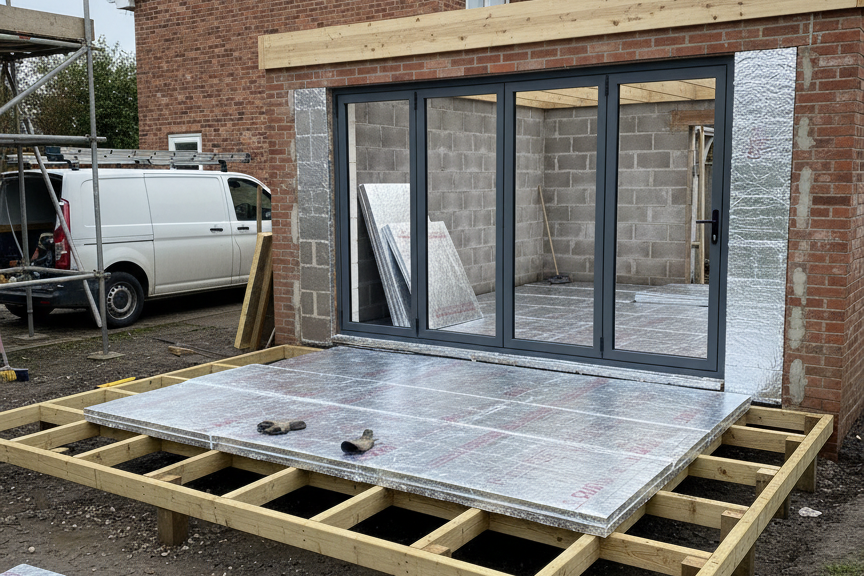
Insulating between the joists runs £80 to £100 per square metre the way we do it: lifting boards carefully, fitting mineral wool or wood fibre on breathable netting, then relaying the original boards rather than replacing them. A front room and hallway, around 25 square metres, lands at roughly £2,000 to £2,500. If water underfloor heating is on your wish list, do the insulation at the same time. Heating an uninsulated void is money poured straight into the ground.
Loft top-ups are the cheapest thing on this list by a distance. Taking an existing layer up to 300mm costs £600 to £1,100 for most houses, depending on size and how awkward the access is. Insulate the hatch and lag the pipework while you're up there.
Windows, sash draughts and conservation rules
Large parts of central Winchester fall inside conservation areas, and there's plenty of listed stock. Swapping original sashes for uPVC is usually a non-starter, and it'd be a shame anyway. Two things work instead.
Draught-proofing the existing sashes, with brush seals routed into the meeting rails and staff beads, is unglamorous and quietly effective. Per pound spent, it's often the biggest comfort improvement in an old house.
Secondary glazing sits behind the original window on a slim aluminium or timber sub-frame. We fit it at £420 to £660 per window supplied and installed, so a full house of eight to ten windows comes to about £3,700 to £5,400. A few things worth knowing:
It's normally treated as removable, so planning permission isn't usually required. Listed building consent is a separate conversation, and we'll tell you straight if you need it.
It's roughly half the cost of full replacement windows and keeps the original glass and joinery intact.
The acoustic gain is significant if you're anywhere near Andover Road or the ring road.
The order we'd do it in
Budgets rarely stretch to all of it at once. If you're phasing the work, this is the sequence we'd suggest:
Draught-proofing and the loft. The cheapest money you'll spend, and you'll notice it inside a week.
Suspended floors, especially if the boards are coming up for refinishing anyway.
Internal wall insulation on the coldest rooms only, usually the front bedroom and whatever room has two external walls.
Secondary glazing.
Heating last. Once the fabric is sorted you may need a smaller system than you thought, and sizing a boiler to the old heat loss is a well-worn way to waste a few thousand pounds.
Related reading
Book a survey with us
We work across Hampshire and Dorset, and period retrofit makes up a good share of the renovation and building work we take on. Every figure above is what we'd charge, not a national average, but the only number you can properly rely on comes after someone has lifted a board and looked underneath. If you've got a cold period house in Winchester, Alresford or the villages around, book a survey with us and we'll walk it room by room with you.


Comments