Driveway Ideas for Bournemouth & Poole Homes in 2026

Driveway ideas are usually the first thing Bournemouth and Poole homeowners ask us about once the big indoor jobs are done, and fair enough: it's the first thing anyone sees when they pull up outside. A cracked, stained concrete drive can make a lovely 1930s semi in Moordown or a newer home in Canford Heath look tired, and a well-designed one does the exact opposite.
Below are the designs we're laying most often across the conurbation this year, what they cost with us, and the practical stuff (drainage, sandy ground, EV cables) that decides whether a driveway still looks good in ten years' time.

Resin-bound with a block paving border
This is the look we get asked for more than any other right now. A resin-bound centre in a warm buff or silver-grey aggregate, framed by a single or double row of charcoal block paving. The border gives the edge a crisp line and stops the resin looking like one big slab, which matters on the wider plots you get in Talbot Woods and Lower Parkstone.
Resin-bound is porous, so rain drains straight through it. That suits a lot of Poole and Bournemouth front gardens, which sit on sandy, free-draining ground. On a full dig-out with a new sub-base, our customers typically pay £100 to £155 per m², which puts a typical 40m² two-car drive at roughly £4,000 to £6,200. If your existing tarmac or concrete is sound, resin can sometimes go straight over it at around £60 to £85 per m². We'll tell you honestly on the survey whether your old base is good enough. Quite often it isn't.
Block paving and porcelain for a sharper finish
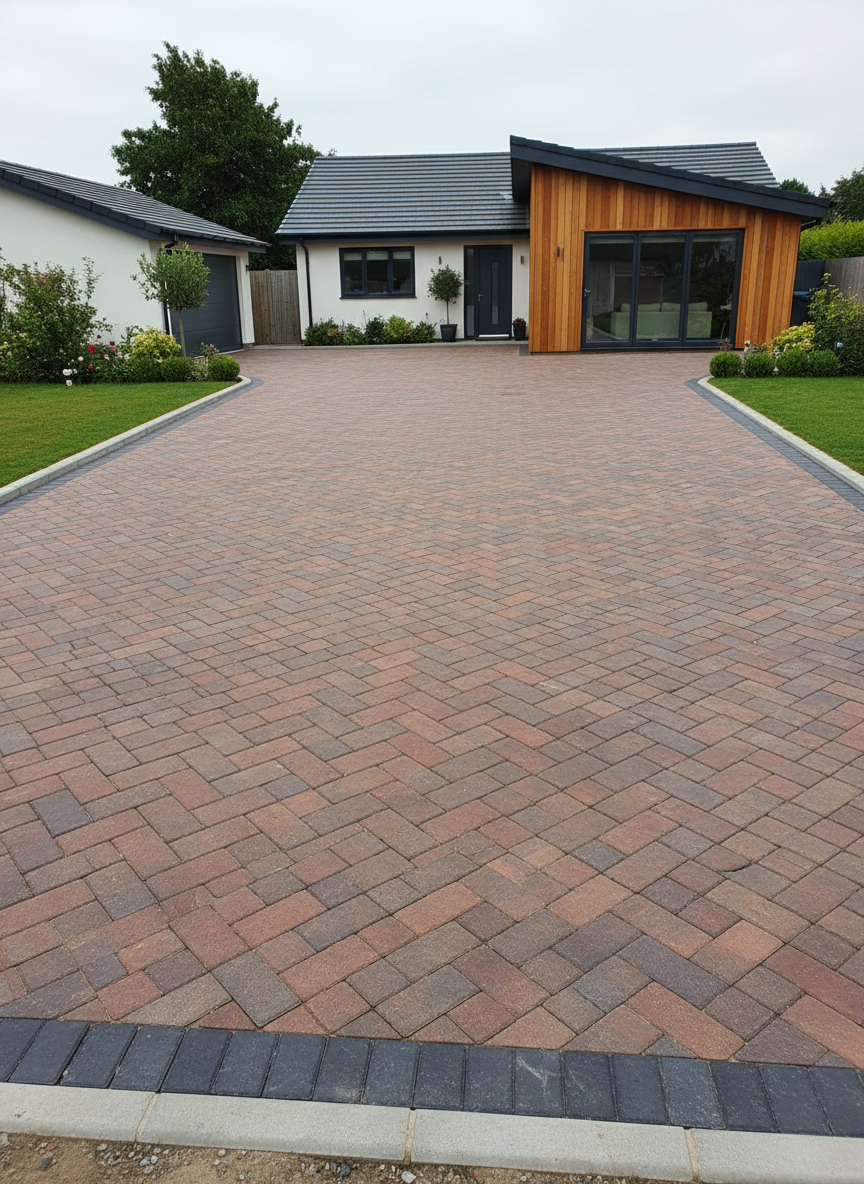
Block paving has been around forever, but the 2026 versions look a lot cleaner. Large-format, flat-top blocks in graphite or silver, laid herringbone or in a simple stretcher bond, suit the newer builds around Canford Heath and Broadstone. Expect around £120 to £180 per m² with us for a properly excavated and compacted drive, depending on the block and the pattern.
At the top end, porcelain and natural stone drives are turning up on the bigger houses in Sandbanks, Branksome Park and Southbourne. They look stunning, but they need a concrete base and vehicle-rated slabs (20mm minimum, often thicker), so you're looking at roughly £180 to £240 per m² and upwards. One thing we'll always steer you away from: patio-grade porcelain on a drive. It cracks under a car, usually within the first winter.
Gravel, planting and lighting
Not every drive needs a big budget. Gravel laid on stabilising grids, so it doesn't end up in the road, comes in at around £60 to £85 per m² with us. It's noisy underfoot (some people like that as a security feature) and it suits cottages in Christchurch and homes on the edge of the New Forest.
Whatever surface you go for, these are the touches that make the biggest difference:
A planting strip along one boundary, with grasses or lavender, which also gives rainwater somewhere to go
Low-level or recessed lights set into the border, which make dark November evenings a lot safer
A contrasting apron where the drive meets the pavement, so the threshold reads clearly
Picking the border colour to match your brickwork or window frames, not in isolation from a brochure
If you're thinking about gates, walls or new fencing as well, do it at the same time. Our exterior works and landscaping team handles the drive, edging, walls and gates as one job, which means your front garden only gets dug up once.
Drainage rules, dropped kerbs and EV cables
Here's the bit people tend to skip. If you're covering more than 5m² of front garden with a hard surface, it either has to be permeable or drain onto a lawn or border within your own boundary. If it doesn't, you'll need planning permission. Resin-bound, gravel and permeable block paving all tick that box; plain concrete or standard block paving running off onto the road don't. We go into more detail in our guide to permeable driveways in Dorset.
Need a new or wider dropped kerb? That's a separate application to BCP Council's highways team, and anything on the public footway has to be built to their spec. We'll help you through it, but allow a few weeks for approval before you fix a start date.
And if there's any chance of an electric car in the next few years, get a duct laid under the new surface while it's all dug out. It costs very little at that stage and saves cutting into a brand new drive later. We do this as standard, and we can fit the charger too. Our EV charger FAQs for Poole and Bournemouth cover the rest.
How long does a new driveway take?
A typical 40m² resin or block paved drive takes us three to five working days: a day or two to break out and clear the old surface, a day or so for sub-base and edging, then laying. Resin needs dry weather and temperatures above about 5°C, so from late autumn we watch the forecast closely and might shift a day. Porcelain on a concrete base usually runs to a week or a little more.
We always survey before quoting. On a Bournemouth or Poole drive that means checking levels against your front door (water needs to fall away from the house, not towards it), finding manholes and inspection chambers that need raising, and seeing what the ground underneath is really like. That's where cheap driveways go wrong, and it's the part we never rush.
Related reading
Planning a new driveway in Bournemouth or Poole?
If you'd like a fixed quote for a new driveway, border, lighting or gates anywhere in Bournemouth, Poole, Christchurch or further across Dorset and Hampshire, book a free site survey with Complete Builds. We'll measure up, check the levels and drainage, and talk you through which of these ideas suits your house and your budget.


Comments