Garden Gyms & Studios in Dorset: Your FAQs

Most weeks now, at least one quote request that lands with us is for a garden gym or a studio rather than an office. Some of that is people tired of driving to a packed leisure centre in Poole for a 6am class. Some of it is Pilates instructors and personal trainers around Wimborne and Broadstone who'd rather teach from home than rent space by the hour. Either way, the building has to work harder than a garden office ever does, and that changes how we build them.

We've built garden offices, gyms and studios across Dorset, and the same questions come up on nearly every site visit. Here are the honest answers, with the 2026 numbers we'd actually put on a quote.
Do I need planning permission for a garden gym?
Usually not. A single-storey garden building sits under permitted development for most Dorset houses, as long as it stays under 2.5 metres tall within 2 metres of a boundary and your outbuildings cover less than half the garden between them. A gym counts as incidental use, same as an office, so the rules don't care whether you fill it with dumbbells or a desk.
The exceptions are what catch people out. Conservation areas in Wimborne Minster and parts of Christchurch tighten things up, listed properties always need consent, and flats don't get permitted development rights at all. We check all of this before we quote, so you're not the one wading through the planning portal.
What does a garden gym cost in Dorset in 2026?
For a fully insulated 3m by 4m gym you can train in all year, plastered and painted inside with double glazing and proper doors, most of our builds land between £22,000 and £28,000. A bigger studio, say 15 square metres with room for a reformer or small classes, runs up to around £34,000. Per square metre you're looking at £1,700 to £2,600 depending on spec. What moves the number:
The base. A concrete slab costs more than ground screws, but it's what we'd suggest if heavy lifting is the plan.
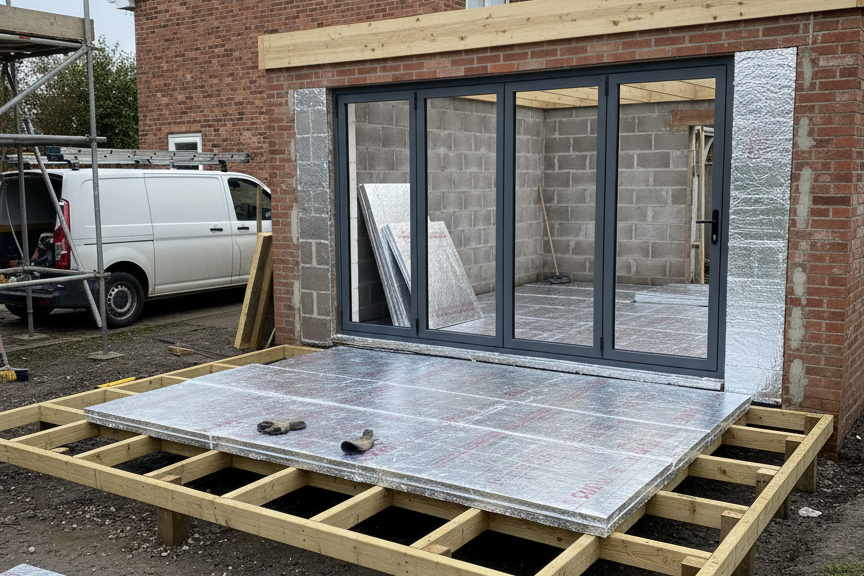
Insulation and heating spec. This is the difference between a building you use in January and one you don't.
Glazing and doors. Big sliders look brilliant and cost accordingly.
How far the building sits from the house, which drives the electrics (more on that below).
You'll see cheaper buildings advertised, and for storing bikes they're fine. An uninsulated cabin with a treadmill in it gets abandoned by February, though. We've been asked to insulate a few of them after the fact, and it always costs more than building it right the first time.
Will the floor take a squat rack and dropped weights?
This is where a gym genuinely differs from an office. A loaded barbell coming down from hip height is a point load no standard garden room floor is designed for, so tell us how you train when we survey. For weights we'll either upgrade the joist spec and flooring grade or, for serious lifters, pour a slab and build the floor level off that.
On top goes commercial rubber flooring, which we supply and fit at £25 to £45 per square metre depending on thickness, so £350 to £550 covers a typical gym. If you want mirrors, a wall-mounted rack or a TV, say so before we clad the walls. We fix plywood pattressing behind the plasterboard exactly where the fixings will go, which costs pennies during the build compared with retrofitting it later.
What about power, heating and ventilation?
Power runs from your house consumer unit through armoured cable buried in the garden, feeding a small consumer unit in the gym. For most Dorset gardens that's £1,200 to £2,200 installed and certified, though a long run under an existing patio can push past £3,000, which is why we walk the cable route at survey stage. Our own electrical team handles the whole thing, including the Part P paperwork.
For heating we usually suggest a wall-mounted split unit at £1,800 to £2,800 installed, because it cools as well. A gym with two people working hard in it gets warm and humid fast, even in November, and an office-spec panel heater does nothing about that. Proper extract ventilation matters more in a gym than in any garden office we build. Skip it and you'll smell why within a month.
How long does the build take?
Three to four weeks on site for a typical gym, a touch longer if a concrete slab is curing in cold weather. Week one is groundworks and base. Week two the shell and roof go up and the building is weathertight. Weeks three and four cover electrics, insulation, plastering, flooring and snagging. Rain rarely stops us once the roof's on.
One practical note: autumn is exactly the right time to book. Start a build in October and you're training at home in the new year while everyone else queues for a squat rack behind thirty January resolutions.
Thinking about one?
We survey before we quote, always, and the person who prices your gym is the person who runs the build. If a garden gym or studio is on the cards for the new year, book a site visit with Complete Builds and we'll look at the garden, the cable route and the access, then give you a fixed price that holds.


Comments